Table of Contents
- ✔ Customers Want Instant Everything
- ✔ Businesses Save Massive Time
- ✔ Better Decisions With Connected Data
- ✔ You Stay Ahead of Competitors
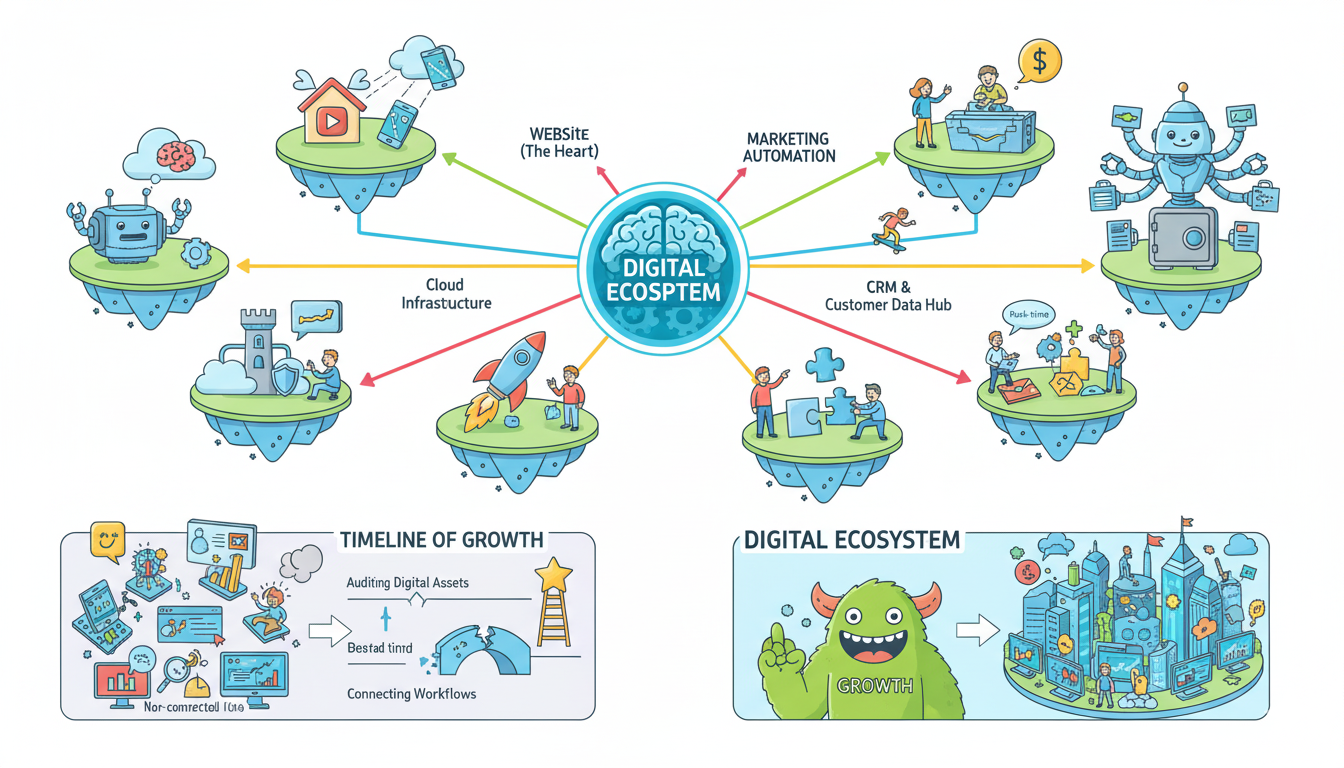
- 1. Website (The Heart)
- 2. Cloud Infrastructure
- 3. CRM & Customer Data Hub
- 4. Marketing Automation
- 5. AI Enhancements
- Step 1: Audit Your Current Digital Assets
- Step 2: Identify Gaps in Customer Experience
- Step 3: Choose the Right Tools
- Step 4: Connect Everything
- Step 5: Automate Workflows
- Step 6: Monitor & Optimize
In a world where customer expectations are rising every second, businesses can no longer depend on isolated tools or a simple website.
2026 marks the era of digital ecosystems — smart, connected systems that integrate your website, apps, CRM, marketing tools, analytics, and automation into one powerful continuous engine.
If you want to scale faster, work smarter, and deliver world-class customer experience, building a digital ecosystem is no longer optional.
It's a necessity.
1. What Exactly Is a Digital Ecosystem?
A digital ecosystem is a network of connected digital tools that work together automatically.
It includes:
-
Your website
-
Mobile apps
-
CRM systems
-
Social media channels
-
Cloud platforms
-
AI tools
-
Marketing automation
-
Analytics tools
Instead of working separately, everything communicates with everything — giving your business superpowers.
2. Why It Matters More Than Ever in 2026
✔ Customers Want Instant Everything
Real-time replies, seamless support, personalized content — an ecosystem makes it possible.
✔ Businesses Save Massive Time
Automation handles:
-
Appointment reminders
-
Lead nurturing
-
Payment links
-
Notifications
-
Email/WhatsApp updates
You focus on growth, not repetitive tasks.
✔ Better Decisions With Connected Data
Your CRM talks to your website.
Your analytics talks to your ads.
Your automation talks to your sales team.
→ Smart, data-driven decisions.
✔ You Stay Ahead of Competitors
Brands that adopt digital ecosystems get higher customer trust and faster growth.
3. Core Components of a Strong Digital Ecosystem
1. Website (The Heart)
Everything connects back to your website.
It is the digital headquarters of your brand.
2. Cloud Infrastructure
Platforms like AWS, Google Cloud, or Azure offer:
-
Fast performance
-
High security
-
Zero downtime
-
Scalability as you grow
3. CRM & Customer Data Hub
Centralizes all customer details:
-
Leads
-
Messages
-
Orders
-
Follow-ups
-
Support requests
4. Marketing Automation
Tools that automate:
-
Emails
-
WhatsApp
-
Retargeting
-
Offers
-
Reminders
-
Feedback collection
5. AI Enhancements
AI boosts your ecosystem with:
-
Chatbots
-
Content generation
-
Predictive analytics
-
Smart recommendations
4. How To Build a Digital Ecosystem (Easy Roadmap)
Step 1: Audit Your Current Digital Assets
List everything you use — website, apps, tools, CRM, social media, etc.
Step 2: Identify Gaps in Customer Experience
Where do customers drop off?
Where are delays happening?
Step 3: Choose the Right Tools
Select affordable, scalable, cloud-ready solutions.
Step 4: Connect Everything
Integrate tools via APIs or automation platforms.
Step 5: Automate Workflows
Eliminate manual tasks that slow growth.
Step 6: Monitor & Optimize
Use analytics to track performance, customer journey, and conversion.
5. The Future: Businesses With Ecosystems Win
Companies that adopt digital ecosystems in 2026 will:
✔ Grow faster
✔ Deliver premium customer experience
✔ Reduce operational costs
✔ Build long-term brand loyalty
✔ Stay far ahead of competitors
A digital ecosystem isn’t just a tech upgrade —
it’s your business growth engine for the next decade.



No comments yet. Be the first to share your thoughts!