Table of Contents
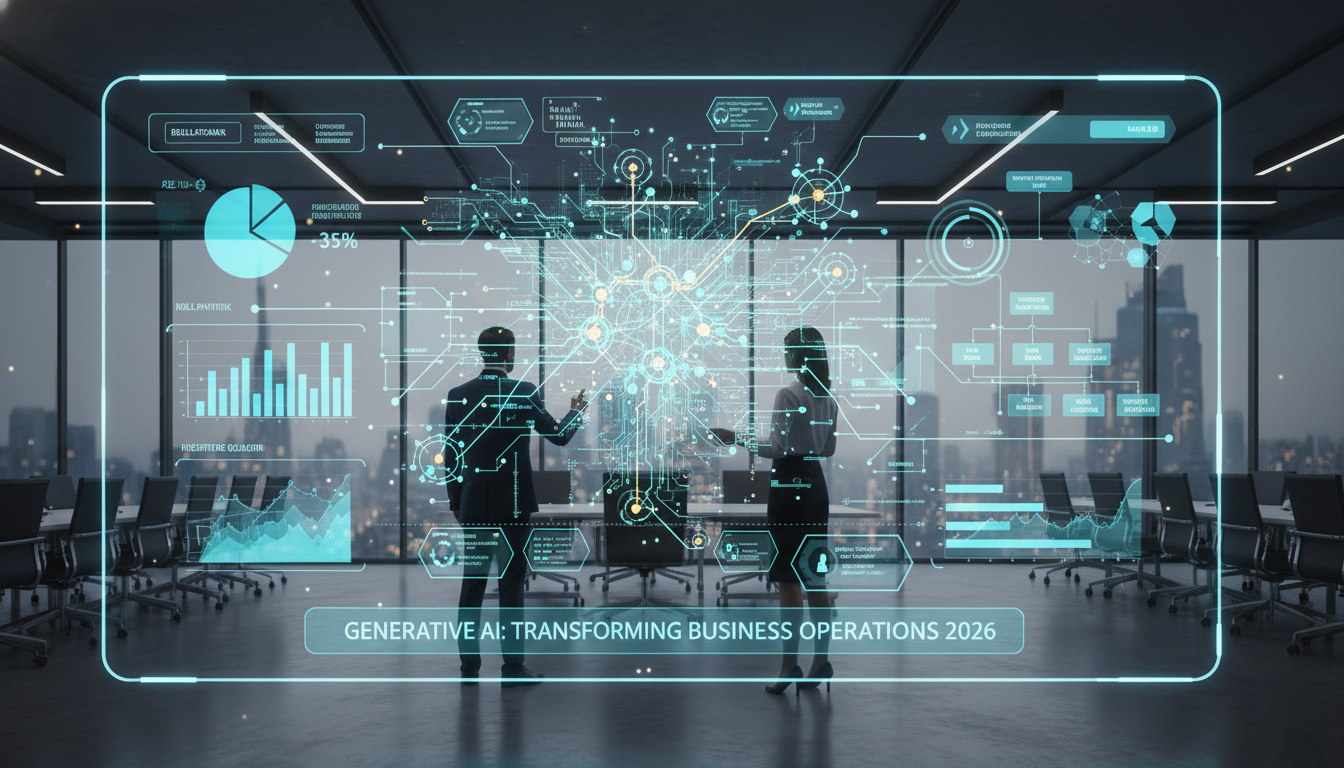
Generative AI has moved far beyond simple text generation. In 2026, businesses across every industry are using AI to automate processes, build smarter workflows, and create personalized customer experiences.
From content creation to data analysis and product development, generative AI has become a powerful engine that drives efficiency and innovation.
This blog breaks down how generative AI is transforming business operations—and why companies that adopt it early will lead the next decade.
1. What Is Generative AI?
Generative AI refers to advanced models capable of creating new content—text, images, video, designs, code, product ideas, and more.
It analyzes patterns in massive datasets to generate human-like outputs.
Common examples:
-
ChatGPT
-
Adobe Firefly
-
Midjourney
-
Gemini
-
GitHub Copilot
2. The Biggest Ways Generative AI Is Transforming Businesses in 2026
✔ 1. Automating Content Creation
Businesses save hours with AI-generated:
-
Social media posts
-
Blogs
-
Product descriptions
-
Email campaigns
-
Ad creatives
This accelerates marketing pipelines while maintaining high quality.
✔ 2. Enhancing Customer Support
AI chatbots now understand context, emotions, and intent. They can:
-
Resolve queries instantly
-
Provide 24/7 support
-
Escalate complex issues
-
Personalize customer responses
This reduces workload and improves customer satisfaction.
✔ 3. Accelerating Product Development
AI helps teams:
-
Prototype faster
-
Generate UI/UX ideas
-
Create design variations
-
Predict user behavior
-
Test multiple product routes
Developers and designers now build in days what used to take weeks.
✔ 4. AI-Assisted Decision-Making
Generative AI can analyze:
-
Sales patterns
-
Market trends
-
Customer data
-
Competitor activities
Businesses get actionable insights and predictions with minimal manual effort.
✔ 5. Streamlining Operations Through Automation
AI now automates:
-
Report generation
-
Invoice processing
-
Email sorting
-
Recruitment screening
-
Inventory predictions
Operational efficiency increases drastically while minimizing errors.
✔ 6. Personalized Customer Experiences
AI tailors experiences based on user behavior—
-
Personalized shopping recommendations
-
Dynamic pricing
-
Customized app interfaces
-
Hyper-targeted marketing
This leads to higher conversions and stronger engagement.
3. Challenges Businesses Should Prepare For
While generative AI offers massive benefits, companies must watch out for:
-
Data privacy concerns
-
Model inaccuracies
-
Ethical usage policies
-
Dependency on automation
-
Need for human oversight
Smart adoption = biggest results.
4. The Future of Generative AI in Business
By 2030, generative AI will be a core component of:
-
Digital ecosystems
-
Product development
-
Workforce automation
-
Decision intelligence
-
Customer experience systems
Companies that invest now will outperform those who wait.
Conclusion
Generative AI is not a trend—it is a foundational technology reshaping modern business.
From smarter operations to better customer engagement and faster innovation, AI is becoming essential for long-term growth.
Businesses that embrace AI today will build the strongest digital advantage for tomorrow.


No comments yet. Be the first to share your thoughts!