Table of Contents
Introduction: Navigating the Cloud Landscape
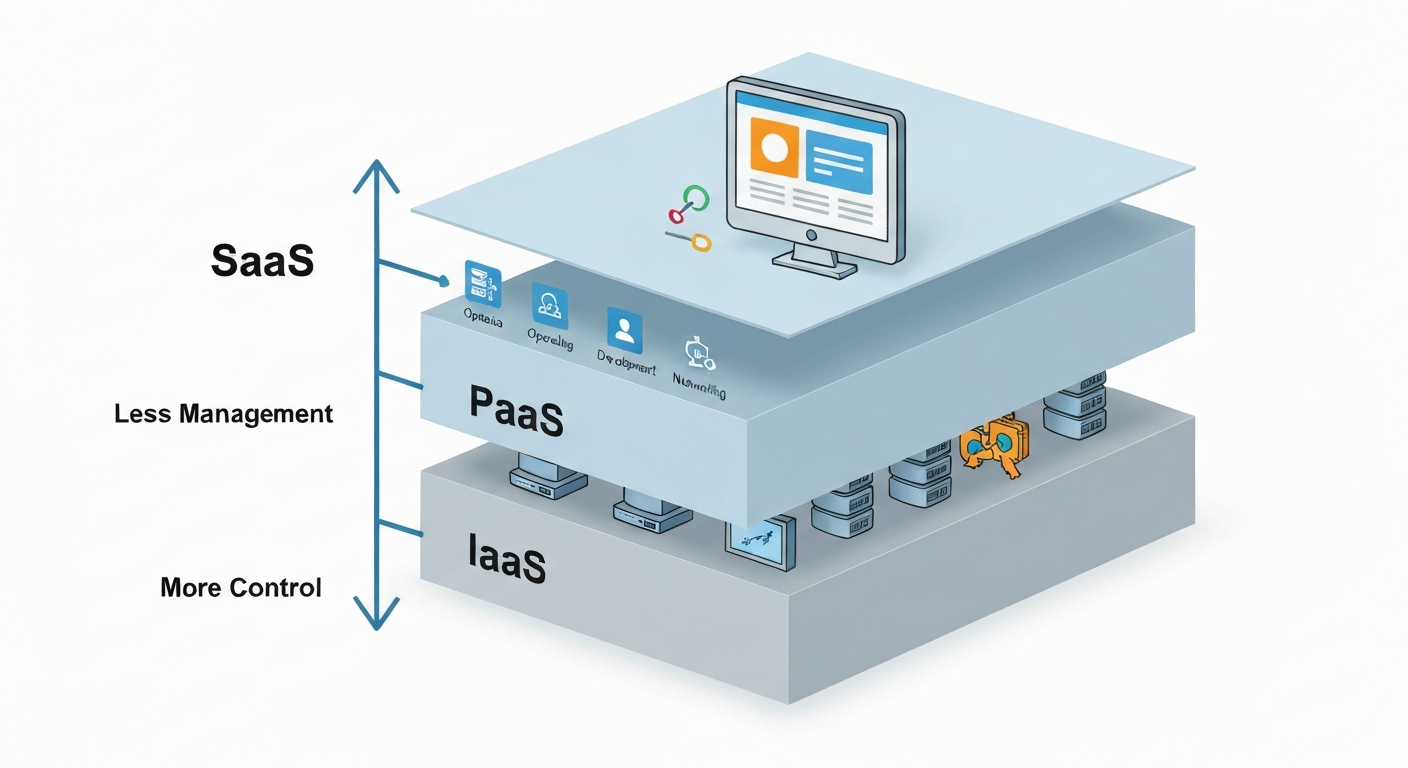
Cloud computing has revolutionized how businesses operate, offering unprecedented flexibility, scalability, and cost-efficiency. But "moving to the cloud" isn't a one-size-fits-all solution. The cloud is offered in different service models, and the three most common are Infrastructure as a Service (IaaS), Platform as a Service (PaaS), and Software as a Service (SaaS).
Choosing the right model is a critical strategic decision that impacts your costs, control, and the amount of technical management your team needs to handle. To make the best choice, let's break down what each model offers using the popular "Pizza as a Service" analogy.
The "Pizza as a Service" Analogy
-
Traditional On-Premise: You make everything from scratch. You buy the flour, tomatoes, cheese; you provide the oven, the gas, the electricity, and the dining table. You have full control, but also full responsibility.
-
IaaS (Infrastructure as a Service): You buy a pre-made pizza base and sauce. You still need to add your own cheese and toppings, bake it in your own oven, and serve it at your own table. The core infrastructure is provided, but you manage the rest.
-
PaaS (Platform as a Service): You order a pizza for delivery. The pizza place handles everything—the dough, sauce, toppings, and baking. You just need to provide the table and drinks. The platform for creating the final product is managed for you.
-
SaaS (Software as a Service): You go out to a restaurant to eat pizza. You don't manage anything. You just show up, order, and eat. The entire experience is provided as a service.
Now, let's apply this to technology.
IaaS: Infrastructure as a Service
IaaS provides the fundamental building blocks of computing infrastructure—virtual servers, storage, and networking—on a pay-as-you-go basis. You rent the IT infrastructure from a cloud provider like Amazon Web Services (AWS) or Microsoft Azure.
-
What You Manage: The application, data, runtime, middleware, and the operating system.
-
What the Provider Manages: The servers, storage, networking, and virtualization.
-
Best For: DevOps teams, system administrators, and businesses that need maximum control and customization over their infrastructure. It’s ideal for hosting complex websites, data analytics, and when you need to migrate existing on-premise applications to the cloud without refactoring.
-
Examples: AWS EC2, Google Compute Engine, Microsoft Azure Virtual Machines.
PaaS: Platform as a Service
PaaS provides a complete development and deployment environment in the cloud. It abstracts away the underlying infrastructure, allowing developers to focus solely on building, testing, and deploying their applications without worrying about server management, software updates, or operating systems.
-
What You Manage: The application and data.
-
What the Provider Manages: Everything else, including the OS, middleware, runtime, servers, and storage.
-
Best For: Developers and development teams. PaaS is perfect for agile environments where the focus is on rapid application development and deployment. It provides a framework that developers can build upon to create customized applications.
-
Examples: Heroku, AWS Elastic Beanstalk, Google App Engine.
SaaS: Software as a Service
SaaS is the most common cloud model. It delivers ready-to-use software applications over the internet, usually on a subscription basis. With SaaS, you simply connect to the application through a web browser, and the provider handles all the infrastructure, software, and maintenance.
-
What You Manage: Nothing. You just use the software.
-
What the Provider Manages: Everything. The entire stack is managed by the vendor.
-
Best For: End-users and businesses looking for out-of-the-box solutions without any IT overhead. It's ideal for email, CRM, ERP systems, and collaborative tools.
-
Examples: Google Workspace, Salesforce, Dropbox, Acadify's School ERP.
Conclusion: The Right Model for the Right Job
There is no single "best" cloud service model; the right choice depends on your business needs, technical expertise, and goals.
-
Choose IaaS for maximum control and flexibility.
-
Choose PaaS to accelerate development and focus on your application code.
-
Choose SaaS for a turnkey, maintenance-free software solution.
Understanding these models is the first step toward building a successful cloud strategy. At Acadify Solution, we provide expert cloud services, helping you navigate the complexities of the cloud, choose the right architecture, and build scalable applications that drive your business forward.


No comments yet. Be the first to share your thoughts!