
Table of Contents
- ✔ 1. Faster Time to Market
- ✔ 2. Reduced Development Cost
- ✔ 3. Real User Feedback
- ✔ 4. Lower Business Risk
- ✔ 5. Easier Investor Validation
- 1. Clear Problem Statement
- 2. Core Features Only
- 3. Simple UI/UX
- 4. Scalable Architecture
- 5. Analytics & Feedback System
- Step 1: Identify the problem
- Step 2: Research target users
- Step 3: Define core features
- Step 4: Design simple UI/UX
- Step 5: Build MVP using agile methods
- Step 6: Launch & collect feedback
- Step 7: Iterate and improve
1. What Is an MVP?
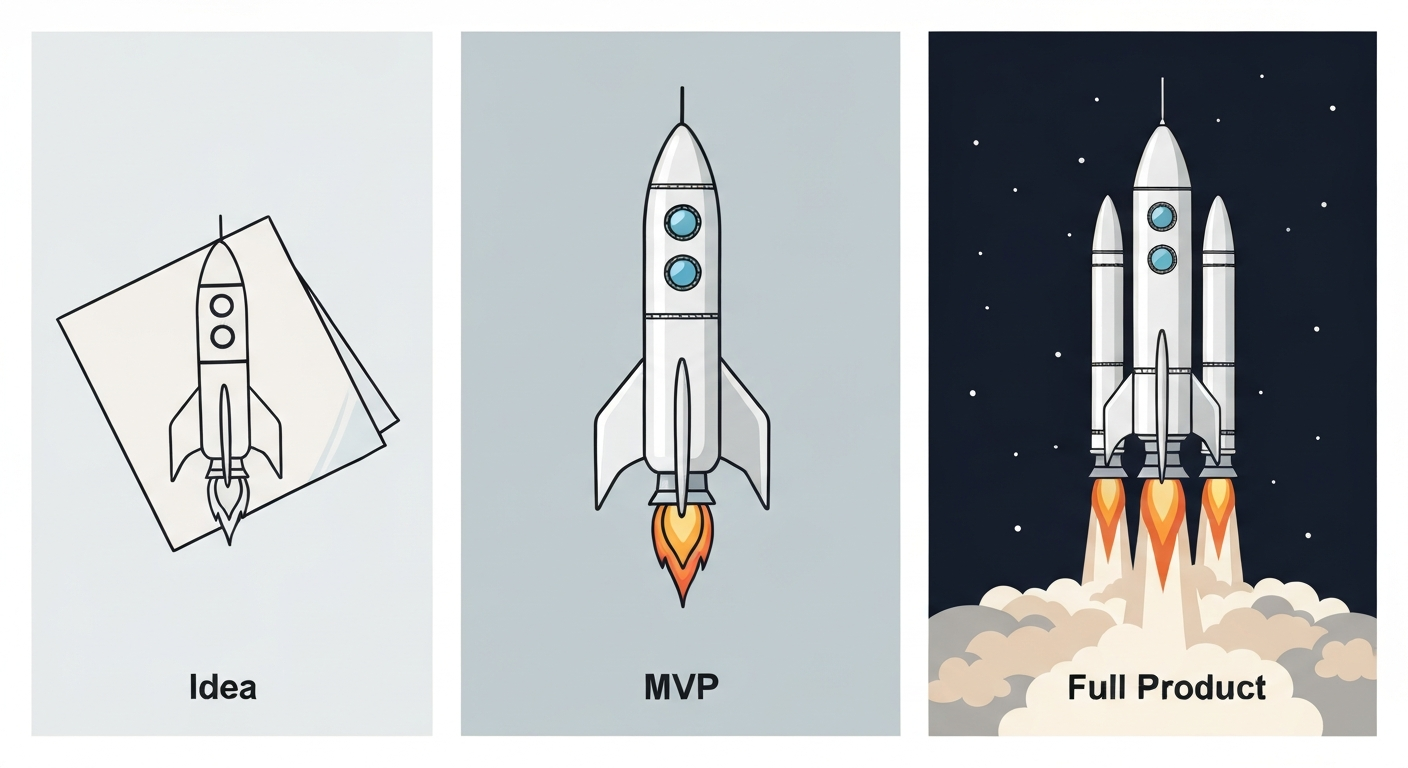
An MVP (Minimum Viable Product) is the simplest version of a product that includes only the core features needed to solve a specific problem for users.
It is built to:
-
Validate an idea
-
Test market demand
-
Collect real user feedback
-
Improve before full development
An MVP is not a final product—it is a learning tool.
2. Why MVPs Are More Important Than Ever in 2026
✔ 1. Faster Time to Market
MVPs allow startups to launch quickly instead of spending months or years building unnecessary features.
✔ 2. Reduced Development Cost
By focusing only on essential features, businesses avoid wasting money on features users may never need.
✔ 3. Real User Feedback
Instead of guessing, MVPs let you observe how real users interact with your product and what they actually want.
✔ 4. Lower Business Risk
Early validation helps founders avoid building products that fail after full launch.
✔ 5. Easier Investor Validation
Investors prefer startups with a working MVP over just an idea.
An MVP proves market interest and execution capability.
3. Key Components of a Successful MVP
1. Clear Problem Statement
Your MVP must solve one core problem, not many.
2. Core Features Only
Include only must-have features.
Avoid advanced customization, complex dashboards, or secondary functions.
3. Simple UI/UX
Clean, intuitive design matters—even in MVPs.
Users should easily understand how to use the product.
4. Scalable Architecture
Even an MVP should be built in a way that allows future scaling and feature expansion.
5. Analytics & Feedback System
Track user behavior and collect feedback to guide future improvements.
4. MVP vs Full Product (Quick Comparison)
| MVP | Full Product |
|---|---|
| Core features only | All features |
| Faster launch | Longer development |
| Lower cost | Higher cost |
| Learning-focused | Growth-focused |
| User feedback driven | Market expansion driven |
5. Common Mistakes to Avoid While Building an MVP
-
Adding too many features
-
Ignoring user feedback
-
Over-engineering the product
-
Poor UI/UX
-
No clear validation goal
-
Delaying launch unnecessarily
A successful MVP is simple, focused, and fast.
6. MVP Development Process in 2026
Step 1: Identify the problem
Step 2: Research target users
Step 3: Define core features
Step 4: Design simple UI/UX
Step 5: Build MVP using agile methods
Step 6: Launch & collect feedback
Step 7: Iterate and improve
7. Who Should Build an MVP?
-
Startups validating ideas
-
Businesses launching new products
-
Enterprises testing new markets
-
SaaS platforms
-
EdTech, FinTech, HealthTech startups
-
Digital service platforms
Conclusion
In 2026, smart businesses don’t build big products first—they build smart MVPs.
An MVP reduces risk, saves time, validates ideas, and creates a strong foundation for long-term success.
Building an MVP is not about doing less—it’s about building what truly matters first.


No comments yet. Be the first to share your thoughts!