Table of Contents
Introduction: The Heartbeat of a Great Product
In the digital product world, you constantly hear the terms "UI" and "UX" thrown around. Often, they are used interchangeably, but this is a fundamental mistake. While User Interface (UI) and User Experience (UX) are deeply intertwined and both are crucial for a product's success, they represent two distinct and separate disciplines.
Understanding the difference isn't just academic; it's a business imperative. A product that fails to deliver on either front will struggle to win customers, no matter how powerful its features are. Let's demystify these concepts and explore why getting both right is the key to building products people love.
What is UX Design (User Experience)? The Journey.
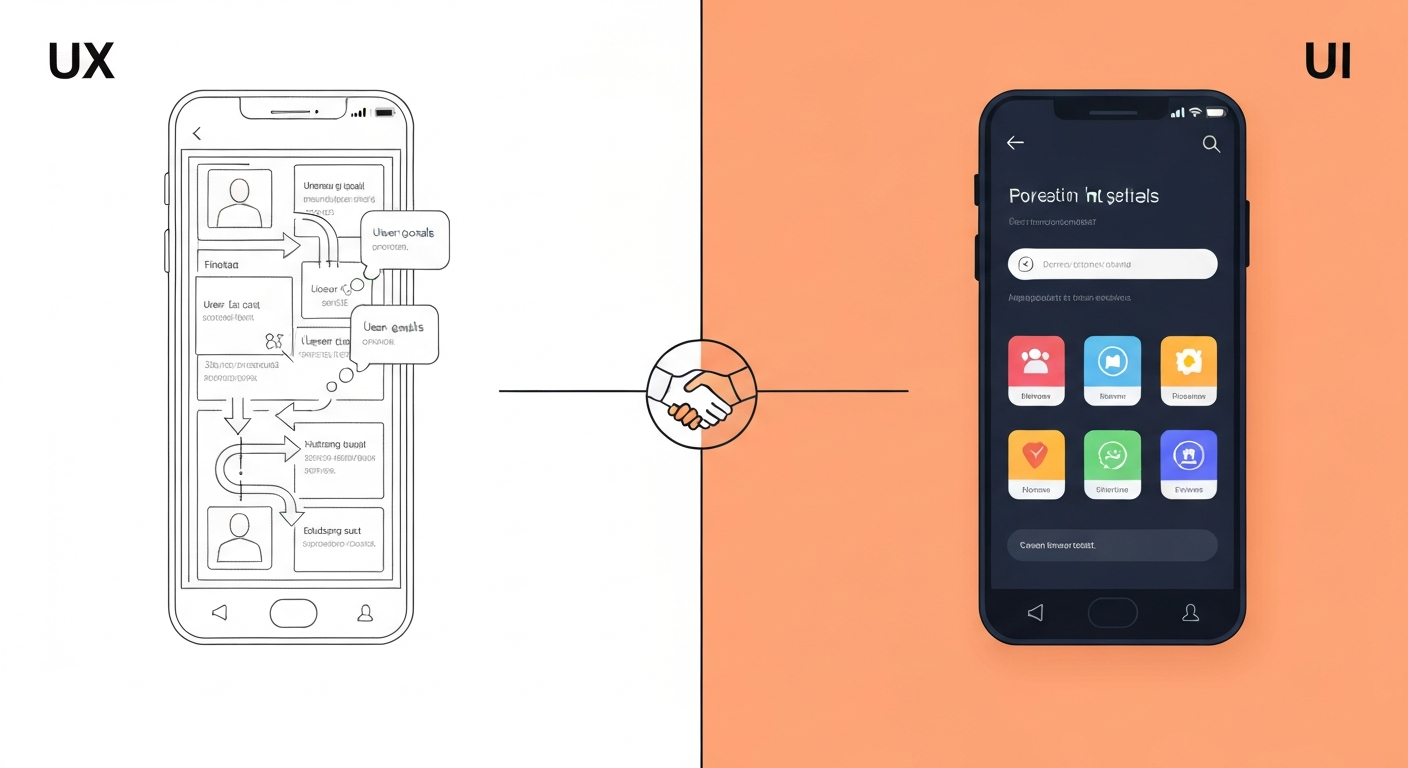
User Experience (UX) design is the holistic process of creating a product that is easy, logical, and enjoyable to use. It's not about how the product looks; it's about how it feels and how it functions from the user's perspective. UX is the invisible architecture of the user's journey.
A UX designer is concerned with the "why" and the "how." They ask questions like:
-
What is the user's primary goal?
-
What is the most logical path for them to achieve that goal?
-
Is the product easy to navigate? Is it intuitive?
-
How can we make the entire interaction as seamless and efficient as possible?
Core Activities: User research, creating user personas, information architecture, wireframing, prototyping, and usability testing.
Analogy: If a product were a house, UX would be the architectural blueprint—the foundation, the number of rooms, the flow between them, and where the doors and windows are placed to make the house livable and functional.
What is UI Design (User Interface)? The Presentation.
User Interface (UI) design is the aesthetic and interactive part of the product. It's the visual presentation of the UX designer's blueprint. UI is what the user actually sees and interacts with—the buttons, the colors, the typography, and the spacing. It's about creating a visually appealing, consistent, and interactive interface.
A UI designer focuses on the "what" and the "look." They ask questions like:
-
What colors and fonts will best represent the brand?
-
Are the buttons and icons easy to understand and click?
-
How does the visual hierarchy guide the user's eye to the most important elements?
-
Is the design consistent across all screens and devices?
Core Activities: Visual design, graphic design, creating style guides, designing interactive elements (buttons, sliders, forms), and ensuring brand consistency.
Analogy: If UX is the blueprint of the house, UI is the interior design—the paint colors, the furniture, the light fixtures, the window dressings, and all the decorative touches that make the house beautiful and pleasant to be in.
Head-to-Head Comparison: UI vs. UX
| Aspect | UX Design (User Experience) | UI Design (User Interface) |
| Primary Focus | The user's journey and problem-solving. | The product's visual look, feel, and interactivity. |
| Goal | To make the product functional, useful, and easy to use. | To make the product beautiful, engaging, and intuitive to interact with. |
| Process | Research, analysis, wireframing, prototyping, testing. | Visual design, branding, graphic development, interactivity. |
| Key Question | "Does this feel logical and effortless?" | "Does this look good and is it easy to interact with?" |
| Outcome | A low-fidelity blueprint or prototype. | A high-fidelity mockup and design system. |
Why You Can't Have One Without the Other
A product with a beautiful UI but terrible UX will ultimately fail. Imagine a stunningly designed car (great UI) with the steering wheel in the back seat (terrible UX). It's useless.
Conversely, a product with a perfectly logical UX but a dated, ugly UI will also fail. Imagine a highly functional car (great UX) that looks like a rusty box. No one will be drawn to it.
Success lies at the intersection of UI and UX. A great product is one that not only functions flawlessly but also looks and feels great to use.
Conclusion: Designing for Your Users and Your Brand
Investing in both UI and UX is investing in your customers. It leads to higher user satisfaction, increased conversion rates, and stronger brand loyalty. When users have a positive experience, they are more likely to become repeat customers and advocates for your brand.
At Acadify Solution, our UI/UX design services are built on this core principle. We blend deep user research (UX) with stunning visual design (UI) to create digital experiences that are not only beautiful but also intuitively solve your users' problems, driving tangible results for your business.


No comments yet. Be the first to share your thoughts!