Table of Contents
Introduction: The Million-Dollar Idea vs. Market Reality
Every great product starts with a brilliant idea. But history is filled with brilliant ideas that failed because they were built in a vacuum. Entrepreneurs often fall into the trap of spending months, or even years, and vast amounts of capital building a "perfect" product with dozens of features, only to launch and discover that nobody actually wants it.
How do you avoid this costly mistake? The answer lies in a strategic, agile approach called the Minimum Viable Product (MVP). It's a methodology that prioritizes learning over assumptions and speed over perfection, and it has become the gold standard for successful startups and innovative enterprises alike.
What Exactly is a Minimum Viable Product (MVP)?
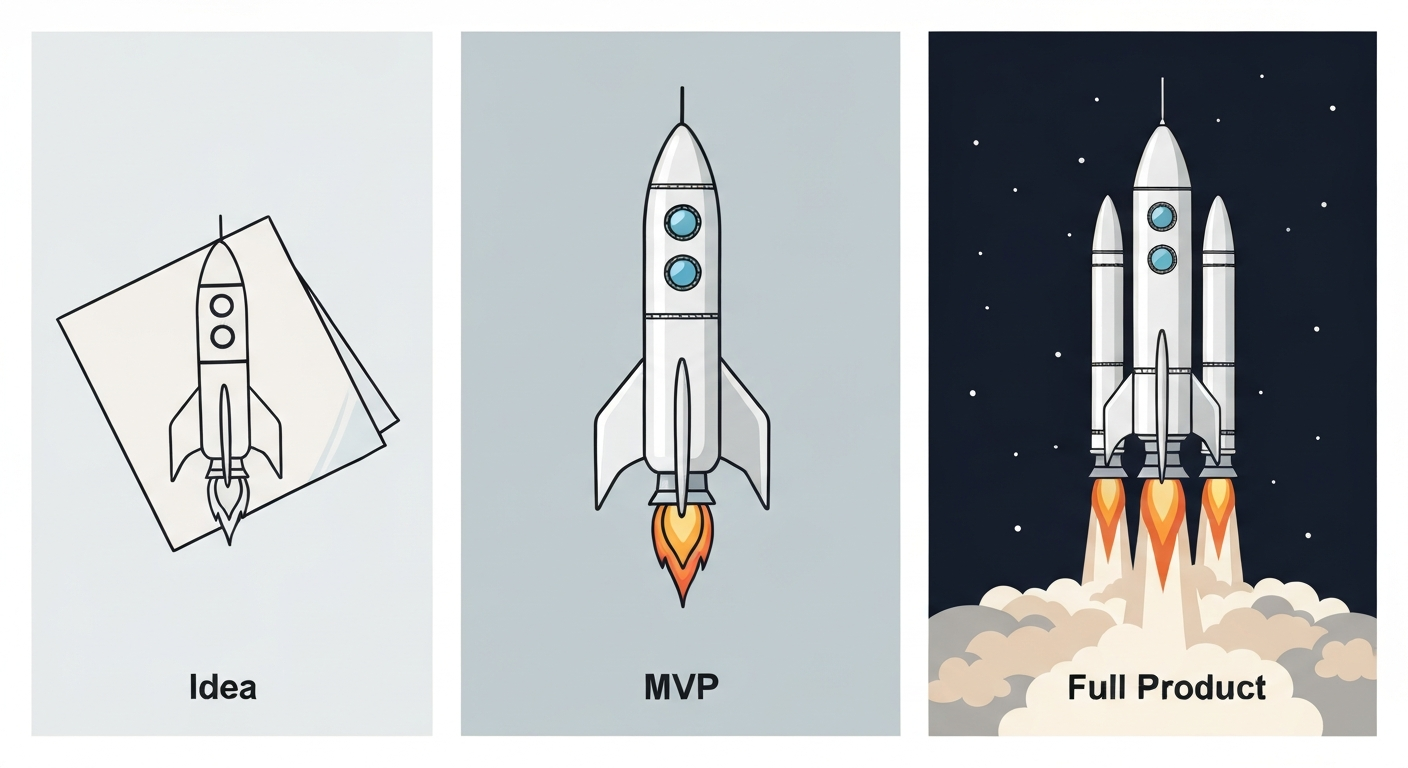
Coined by Eric Ries in "The Lean Startup," a Minimum Viable Product is that version of a new product which allows a team to collect the maximum amount of validated learning about customers with the least amount of effort.
Let's break down the two key components:
-
Minimum: It includes only the most essential, core features that are necessary to solve a primary problem for a specific group of users (early adopters). All the "nice-to-have" features are left for later.
-
Viable: The product must be functional, reliable, and well-designed enough to be usable. It should provide real value and demonstrate the potential of the final product. An MVP is not a buggy or incomplete product; it's a focused one.
Think of it like building a car. Instead of spending a year building the entire car, you start by building a skateboard. It solves the core problem of getting from point A to point B. User feedback on the skateboard then informs how you build the scooter, then the bicycle, and eventually, the car.
The Core Benefits of an MVP Strategy
-
Drastically Reduced Time-to-Market: By focusing only on core features, you can launch your product in a fraction of the time it would take to build a full-featured version. This allows you to get a head start on the competition and begin learning from real users immediately.
-
Cost-Effective Development: Building an MVP is significantly cheaper than developing a complete product. You invest your resources in validating your core idea first, preventing you from wasting your budget on features that users don't need or want.
-
Early User Feedback and Validation: The primary goal of an MVP is to learn. It allows you to test your most critical business hypotheses with real users. Their feedback is invaluable and will guide your future development, ensuring you build a product that people will actually use and pay for.
-
Risk Mitigation: The MVP approach helps you identify potential market risks early on. It's better to find out that your core idea needs tweaking (or is unviable) after a 3-month MVP build than after a 2-year, multi-million dollar project.
-
Attracting Investors: A functional MVP with a growing base of early adopters is powerful proof that you have a viable business idea. It's far more compelling to potential investors than a simple business plan or a slide deck.
MVP vs. Prototype vs. Proof of Concept (PoC)
These terms are often used interchangeably, but they serve different purposes:
-
Proof of Concept (PoC): Answers the question, "Can we build this?" It's a small internal project to test the technical feasibility of an idea.
-
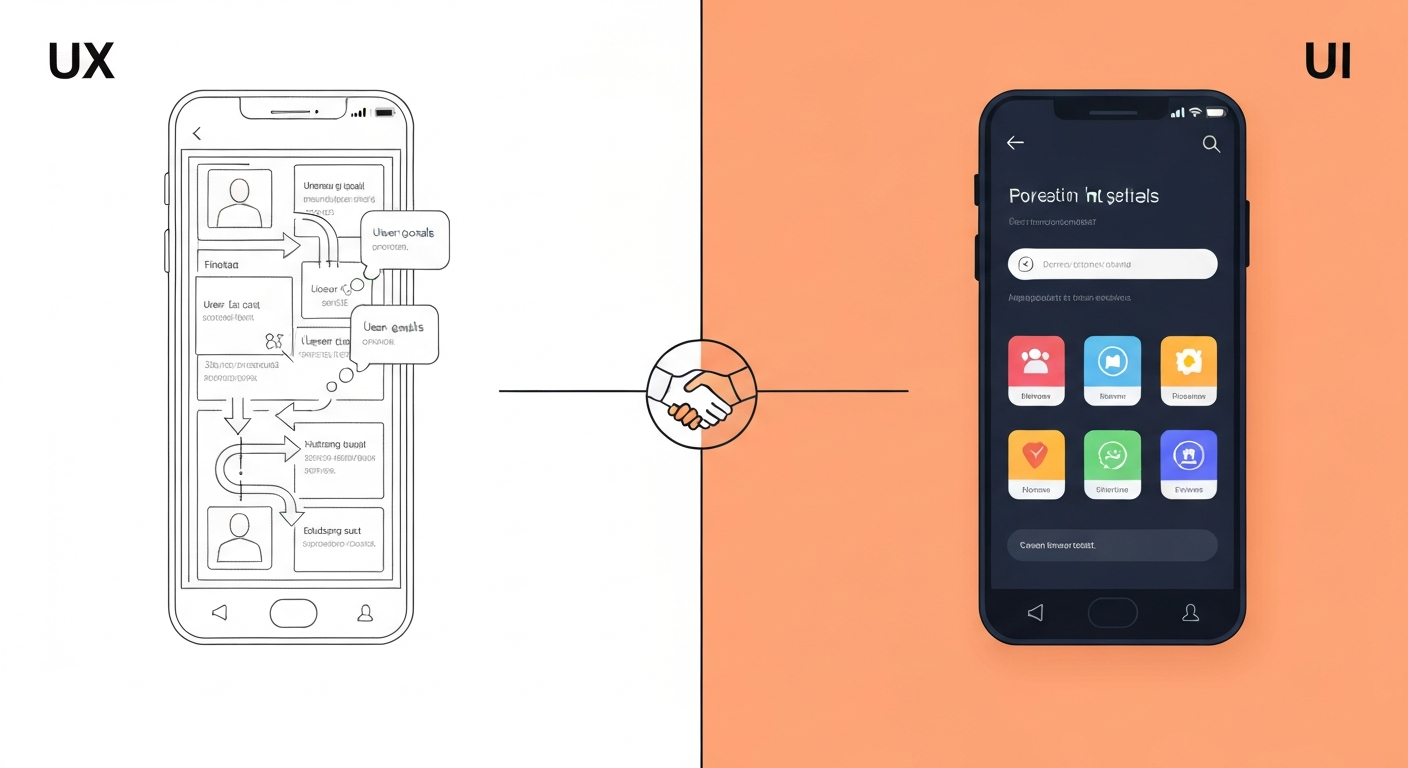
Prototype: Answers the question, "What will this look like and how will it work?" It's a visual, often interactive, mockup of the user interface and user experience.
-
Minimum Viable Product (MVP): Answers the question, "Should we build this?" It's a live, functional product that is released to real users to test the business viability of the idea.
Conclusion: Build, Measure, Learn
The MVP approach is more than just a development tactic; it's a business philosophy. It's about being smart, agile, and customer-centric. By launching a Minimum Viable Product, you replace risky assumptions with validated learning, ensuring that your time, money, and effort are invested in building a product that truly resonates with the market.
At Acadify Solution, we specialize in helping startups and businesses transform their ideas into successful products. Our MVP development services are designed to get you to market quickly, enabling you to test your vision and build a foundation for future growth.



No comments yet. Be the first to share your thoughts!