
Table of Contents
- Why Traditional Software Testing Is Not Enough
- The Hidden Cost of AI Failures
- What AI Reliability Testing Actually Measures
- Hallucination Testing Beyond Simple Accuracy Checks
- Detecting Behavioral Drift Before Users Notice
- The Importance of Retrieval Validation
- Building Automated AI Evaluation Pipelines
- Observability Completes The Reliability Strategy
- A Realistic Enterprise Reliability Scenario
- Why Reliability Will Define Enterprise AI Success
Enterprise AI projects rarely fail because the underlying model lacks intelligence. Most failures happen because organizations deploy AI systems without understanding how unpredictable production environments can become.
A chatbot performs flawlessly during demonstrations. An internal AI assistant answers every test question correctly. A retrieval system appears accurate when evaluated against carefully curated examples.
Then production begins.
Customer conversations become more complex. Knowledge bases change weekly. Teams modify prompts. New integrations introduce unexpected context. Suddenly the same AI system that looked reliable in testing starts producing inconsistent responses, incorrect recommendations, and operational confusion.
This is precisely why AI reliability testing has become one of the most important disciplines in enterprise AI engineering.
Organizations investing heavily in AI are discovering that model capability alone is not enough. Reliability determines whether an AI system becomes a trusted business asset or an expensive operational risk.
Why Traditional Software Testing Is Not Enough
Conventional software systems operate through deterministic logic. Given identical inputs, they produce identical outputs. Testing methodologies evolved around this predictability.
Large language models behave differently.
Even with identical prompts, outputs can vary. Responses depend on context windows, retrieval quality, model versions, prompt structures, temperature settings, and countless environmental factors.
This creates a unique challenge for engineering teams.
An AI application may pass functional testing while still exhibiting hidden reliability issues that only emerge under production conditions.
For example, a customer support AI might answer common questions correctly while struggling with ambiguous requests, conflicting policy documents, or edge cases that were absent during development testing.
Traditional QA frameworks rarely capture these behaviors effectively.
AI reliability testing fills this gap by evaluating not only whether systems function but whether they remain trustworthy, consistent, and accurate across thousands of real-world scenarios.
The Hidden Cost of AI Failures
Enterprise AI failures rarely appear as dramatic outages.
More often, they emerge as subtle operational problems.
An AI sales assistant may generate inaccurate product recommendations. A compliance assistant may overlook critical policy exceptions. An internal knowledge system may retrieve outdated information while appearing completely confident.
These issues are dangerous because they are difficult to detect immediately.
Unlike infrastructure outages that trigger alerts instantly, AI failures often spread quietly through workflows before stakeholders recognize the problem.
One SaaS organization implementing an AI-powered support assistant observed declining customer satisfaction despite stable infrastructure metrics. Initial investigations focused on latency and uptime.
The actual problem was semantic degradation.
As documentation expanded, retrieval relevance decreased. The system remained operational, but answer quality steadily declined. Support escalation rates increased by 23 percent before the root cause was identified.
This scenario has become increasingly common across enterprise AI deployments.
What AI Reliability Testing Actually Measures
Many teams assume AI testing simply means checking whether answers are correct.
Enterprise-grade reliability testing is significantly broader.
A mature testing framework evaluates multiple dimensions simultaneously:
- Response accuracy
- Hallucination frequency
- Retrieval relevance
- Behavior consistency
- Prompt sensitivity
- Safety compliance
- Latency performance
- Workflow stability
- Model drift
- Context retention
Each dimension influences overall system reliability.
A model that generates accurate responses but exhibits unstable behavior after prompt modifications can still create substantial operational risk.
Similarly, a retrieval pipeline with strong performance today may degrade gradually as enterprise knowledge repositories evolve.
Reliability testing helps engineering teams identify these risks before users experience them.
Hallucination Testing Beyond Simple Accuracy Checks
Hallucinations remain one of the most widely discussed AI challenges, yet many organizations approach them incorrectly.
They often test only obvious factual inaccuracies.
In production environments, hallucinations are frequently more subtle.
An AI assistant may reference genuine company policies while incorrectly combining information from multiple documents. A procurement system may produce realistic approval recommendations that contain incorrect financial thresholds.
The output appears credible.
The language sounds professional.
The mistake is hidden inside otherwise convincing reasoning.
Effective hallucination testing therefore requires structured evaluation methods that examine groundedness, source attribution, factual consistency, and retrieval alignment rather than relying solely on manual review.
At Acadify AI Labs, hallucination analysis often includes adversarial testing scenarios designed to expose failure patterns that normal user interactions may not reveal immediately.
Detecting Behavioral Drift Before Users Notice
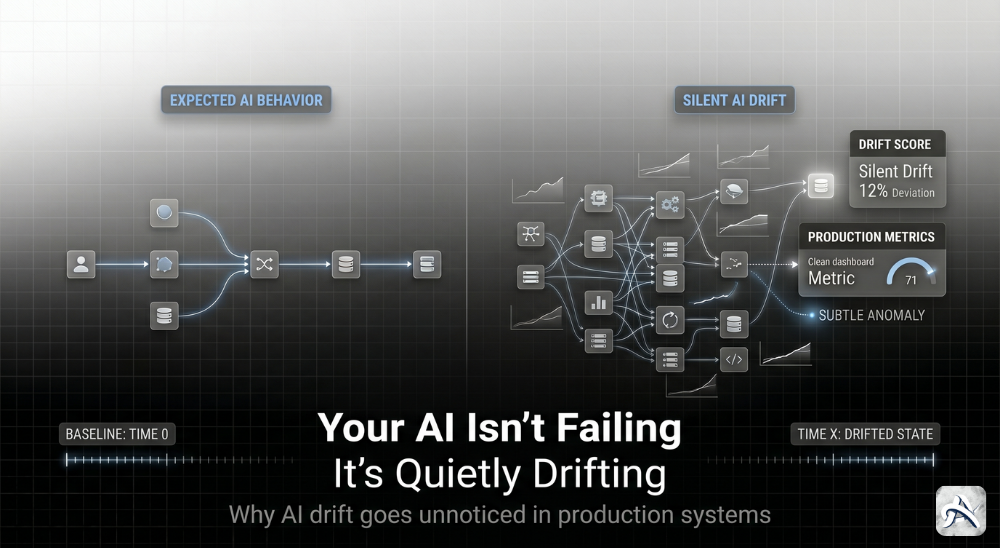
One of the least understood risks in enterprise AI systems is behavioral drift.
Unlike traditional software bugs, drift can occur without code changes.
Knowledge repositories evolve. User behavior changes. New prompts enter workflows. External model providers release updates.
Collectively, these factors can alter system behavior over time.
A finance assistant that performed reliably six months ago may respond differently today despite no obvious infrastructure modifications.
Without continuous evaluation, these changes often remain invisible until business stakeholders begin reporting inconsistencies.
Reliability testing introduces systematic monitoring mechanisms capable of detecting behavior shifts early.
Modern evaluation pipelines compare historical outputs against current outputs, identifying deviations that may indicate emerging reliability concerns.
This approach transforms AI quality assurance from reactive troubleshooting into proactive risk management.
The Importance of Retrieval Validation
Many enterprise AI applications rely on Retrieval-Augmented Generation architectures.
RAG systems improve accuracy by combining language models with organizational knowledge sources.
However, retrieval layers introduce entirely new reliability challenges.
Problems often emerge through:
- Embedding degradation
- Duplicate document ingestion
- Poor chunking strategies
- Metadata inconsistencies
- Outdated vector indexes
- Weak reranking mechanisms
- Knowledge synchronization failures
A model cannot generate trustworthy answers if relevant information never reaches the context window.
For this reason, advanced AI reliability testing evaluates retrieval quality independently from generation quality.
Engineering teams increasingly monitor retrieval precision, document coverage, ranking consistency, and semantic relevance as first-class reliability metrics.
Building Automated AI Evaluation Pipelines
Manual testing becomes impractical as AI systems grow.
An enterprise platform may process thousands of prompts daily across multiple workflows, business functions, and user groups.
Scalable reliability requires automation.
Leading engineering teams now build evaluation infrastructure resembling traditional CI/CD pipelines.
Before deployment, systems automatically execute:
- Regression test suites
- Hallucination detection checks
- Safety validation scenarios
- Retrieval quality benchmarks
- Latency performance tests
- Prompt consistency evaluations
- Workflow simulation exercises
Changes that introduce reliability regressions can be flagged before reaching production environments.
This approach significantly reduces deployment risk while accelerating development velocity.
Instead of slowing innovation, structured testing enables organizations to iterate with greater confidence.
Observability Completes The Reliability Strategy
Testing alone cannot guarantee long-term reliability.
Production systems require continuous observability.
Enterprise AI teams increasingly monitor metrics that extend beyond infrastructure performance.
These include:
- Semantic failure rates
- Escalation frequency
- Response confidence patterns
- Retrieval precision changes
- Token consumption anomalies
- Prompt execution failures
- User correction rates
- Knowledge coverage gaps
Combining observability with reliability testing creates a feedback loop that continuously improves system quality.
Rather than waiting for customer complaints, organizations gain visibility into emerging issues before they impact critical business processes.
A Realistic Enterprise Reliability Scenario
Consider a multinational organization deploying an AI assistant for internal policy management.
The initial rollout performs well. Employees receive quick answers. Support requests decline. Adoption grows rapidly.
Over the following months, hundreds of policy documents are added across departments.
Without reliability testing, retrieval precision begins to degrade. Some policies conflict with newer versions. Duplicate documents enter the knowledge base. Certain responses become less accurate.
The system remains online.
Infrastructure dashboards remain green.
Yet operational trust slowly declines.
With structured reliability testing in place, evaluation pipelines detect retrieval degradation early. Engineering teams identify problematic document clusters, rebuild indexing strategies, improve metadata governance, and restore answer quality before widespread business impact occurs.
This illustrates the fundamental purpose of reliability engineering.
The goal is not merely identifying failures. It is preventing failures from reaching users in the first place.
Why Reliability Will Define Enterprise AI Success
The next phase of enterprise AI adoption will not be driven solely by larger models or more sophisticated prompting techniques.
It will be driven by trust.
Organizations need systems that behave predictably under changing conditions. Executives need confidence that AI-generated outputs align with business requirements. Engineering teams need visibility into performance, quality, and risk.
AI reliability testing provides the foundation for that confidence.
At Acadify Solution and Acadify AI Labs, reliability engineering is increasingly treated as a core architectural discipline rather than a post-deployment activity. The most successful AI initiatives are not simply built faster. They are validated continuously, monitored intelligently, and engineered for long-term operational trust.
As enterprise AI becomes embedded in customer service, operations, finance, healthcare, compliance, and decision-making workflows, reliability will become the defining factor separating successful deployments from expensive experiments.


No comments yet. Be the first to share your thoughts!