Table of Contents
- The Proof of Concept Trap
- The Data Problem Nobody Solves Early
- Security Changes Everything
- Reliability Becomes The Real Challenge
- Integration Complexity Is Underestimated
- Model Quality Is Only One Variable
- The Missing Observability Layer
- Executive Expectations Create Pressure
- What Successful AI Deployments Do Differently
- The Rise Of Production AI Engineering
Most enterprise AI projects do not fail because the models are weak.
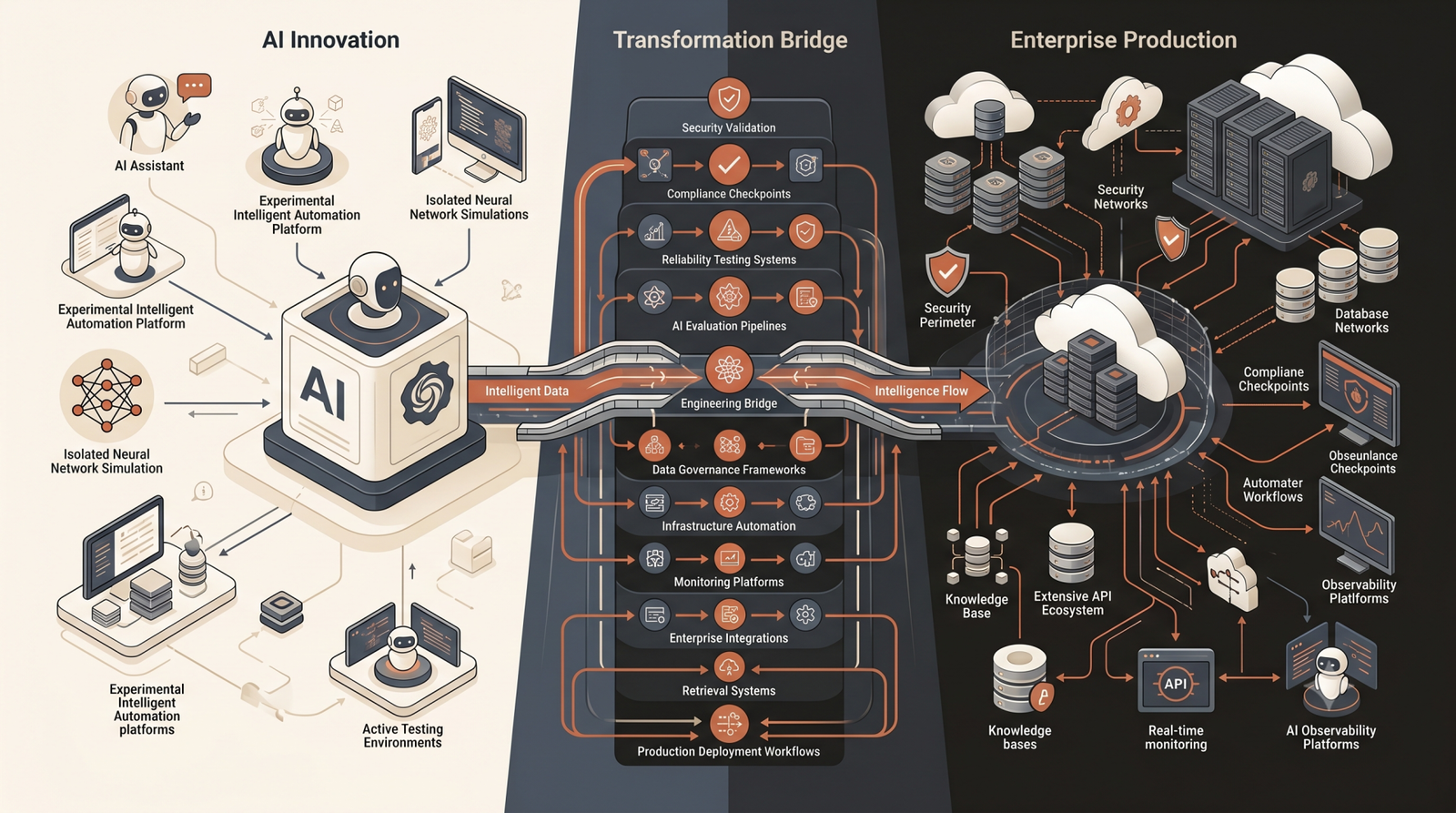
They fail because organizations underestimate what happens between a successful proof of concept and a production deployment.
The first demo impresses stakeholders. The chatbot answers questions accurately. The AI assistant generates useful outputs. Internal teams become excited about the possibilities.
Need MVP Development or AI Solutions?
Turn your idea into reality with Acadify. Fast, scalable, and built for enterprise growth.
Then reality arrives.
Security reviews begin. Infrastructure teams raise concerns. Compliance departments request audits. Data quality issues emerge. Integration requirements expand. Reliability questions surface. Suddenly a project that looked ready for deployment becomes trapped in months of uncertainty.
This is the stage where most enterprise AI initiatives lose momentum.
The challenge is not building an AI demo. The challenge is building an AI system that organizations can trust, scale, govern, and operate continuously.
That gap explains why so many AI initiatives never successfully reach production environments.
The Proof of Concept Trap
Many organizations mistake proof of concept success for production readiness.
A proof of concept exists to demonstrate possibility.
A production system exists to deliver predictable business outcomes.
Those are entirely different objectives.
During the proof-of-concept phase, teams often work with clean datasets, controlled prompts, limited users, and ideal conditions. The environment is optimized to showcase capability.
Production environments are far less forgiving.
Users ask unexpected questions. Data changes constantly. Workflows evolve. Edge cases emerge daily. Systems must remain available, secure, and accurate regardless of operational complexity.
Many projects fail because organizations never make the transition from experimentation to engineering.
The Data Problem Nobody Solves Early
AI systems depend heavily on data quality.
Unfortunately, enterprise data environments are rarely clean.
Documentation exists across multiple repositories. Internal knowledge is fragmented between teams. Legacy systems contain inconsistent records. Critical information may exist inside emails, PDFs, spreadsheets, and disconnected databases.
AI models cannot compensate for poor information architecture.
Many organizations invest heavily in models while neglecting the underlying data foundation.
The result is predictable.
Outputs become inconsistent because the system lacks access to reliable knowledge.
Before AI can generate trustworthy responses, enterprises must solve information management challenges that often existed long before the AI initiative began.
Security Changes Everything
An AI system may perform perfectly during testing and still fail enterprise approval.
Security teams evaluate risks differently than product teams.
Questions quickly emerge:
- Where is sensitive data stored?
- Can prompts expose confidential information?
- How are user permissions enforced?
- What happens if model outputs reveal protected content?
- How is auditability maintained?
- Which vendors have access to enterprise data?
Many AI projects encounter their first major obstacle during security review.
What appeared to be a straightforward deployment suddenly requires encryption policies, access controls, compliance validation, audit logging, and governance frameworks.
These requirements are essential, but teams often fail to plan for them early.
Reliability Becomes The Real Challenge
Traditional software either works or it does not.
AI systems operate differently.
A large language model may provide excellent responses hundreds of times before producing a confidently incorrect answer.
This creates unique reliability challenges.
Enterprise users expect consistency.
They need systems that behave predictably across thousands of interactions.
When an AI assistant generates different answers to similar questions, confidence erodes quickly.
This is why organizations increasingly invest in AI reliability testing, evaluation pipelines, hallucination detection, and behavioral monitoring.
The goal is not achieving perfection.
The goal is creating systems that remain trustworthy under real-world conditions.
Integration Complexity Is Underestimated
Enterprise AI rarely operates as a standalone application.
It must connect with existing business systems.
That often includes:
- CRMs
- ERP platforms
- Customer support tools
- Internal databases
- Document management systems
- Identity providers
- Analytics platforms
- Workflow automation tools
Every integration introduces new complexity.
Authentication models must align. Data synchronization must remain accurate. Permissions must be respected. Performance must remain acceptable.
Many projects underestimate how much engineering effort is required to integrate AI into existing operational ecosystems.
The AI itself is often the easiest component.
Model Quality Is Only One Variable
Organizations frequently spend months debating which model provider to use.
OpenAI, Anthropic, open-source models, domain-specific models, and custom fine-tuned solutions all receive significant attention.
While model selection matters, it rarely determines project success alone.
A high-performing model deployed inside a poorly designed architecture can still produce disappointing results.
Successful enterprise AI systems rely on multiple layers working together:
- Data pipelines
- Retrieval systems
- Evaluation frameworks
- Security controls
- Monitoring infrastructure
- Feedback loops
- Governance policies
The model is only one component within a much larger operational system.
The Missing Observability Layer
Most organizations monitor servers, databases, and APIs.
Very few monitor AI behavior effectively.
This creates a significant blind spot.
Enterprise teams need visibility into:
- Hallucination rates
- Response quality trends
- Retrieval performance
- Prompt failures
- Latency patterns
- User correction frequency
- Knowledge coverage gaps
Without observability, teams discover problems only after users complain.
Modern AI operations require monitoring systems capable of evaluating both infrastructure health and model behavior.
Organizations that ignore observability often struggle to scale successfully.
Executive Expectations Create Pressure
Enterprise AI projects frequently attract executive attention.
Leadership teams expect measurable outcomes.
They want improvements in efficiency, productivity, customer experience, revenue growth, or operational cost reduction.
When deployment timelines extend unexpectedly, pressure increases.
Teams begin rushing decisions.
Testing is shortened. Validation processes are skipped. Architectural compromises are introduced.
Ironically, these shortcuts often create the very reliability issues that delay production adoption further.
The most successful organizations treat AI implementation as a strategic engineering initiative rather than a race to launch.
What Successful AI Deployments Do Differently
Organizations that consistently move AI systems into production share several characteristics.
They focus on operational readiness from the beginning.
Instead of asking, "Can this model generate useful outputs?" they ask:
- Can this system scale?
- Can we monitor it?
- Can we secure it?
- Can we govern it?
- Can we maintain it?
- Can users trust it?
These questions drive better architectural decisions.
Successful teams invest early in evaluation frameworks, observability, reliability testing, infrastructure automation, and governance controls.
As a result, deployment becomes an extension of engineering maturity rather than an operational gamble.
The Rise Of Production AI Engineering
A new discipline is emerging inside enterprise technology organizations.
Building AI products is no longer solely a machine learning challenge.
It has become a systems engineering challenge.
The companies achieving meaningful AI adoption are combining software engineering, cloud infrastructure, security architecture, reliability testing, product thinking, and operational governance into unified delivery models.
This shift explains why AI deployments increasingly resemble large-scale software initiatives rather than isolated innovation projects.
At Acadify Solution and Acadify AI Labs, this pattern appears repeatedly across enterprise engagements. The projects that reach production are not necessarily those with the most advanced models. They are the projects with the strongest engineering foundations.
Enterprise AI success is rarely determined by what happens during a demo.
It is determined by what happens after the demo, when systems must operate securely, reliably, and predictably every day.
The organizations that understand this distinction will be the ones that transform AI from an experiment into a lasting competitive advantage.
No comments yet. Be the first to share your thoughts!